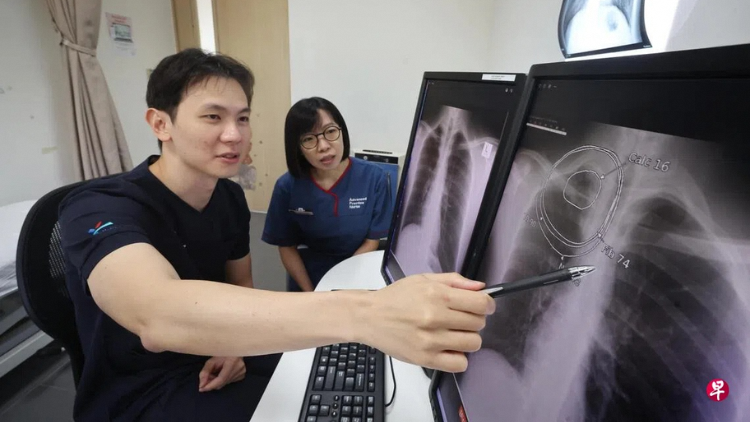
Tuberculosis is a common infectious disease, but unlike COVID-19 and influenza, it lacks rapid diagnostic test kits. Doctors often must rely on subjective experience to search for clues in chest X-rays.
Dr Tay Jun Yang (37), Head of the National Centre for Infectious Diseases (NCID) National Tuberculosis Screening Centre , has been interpreting an average of more than 20 chest X-rays daily over the past five years. He typically spends less than a minute examining each image, becoming alert when white shadows appear in the upper portions of the lungs.
"White shadows also appear in chest X-rays of pneumonia and lung cancer patients, and some white areas are the patient's bronchial branches. We often have to rely on experience to decide whether patients need further examination."
To improve the accuracy and efficiency of image reading, the Tuberculosis Screening Centre has enlisted a tuberculosis reading "assistant" for Dr Tay Jun Yang and others – 12 medical staff in total – since September last year, providing them with an additional pair of "eyes" when interpreting chest X-rays.
This assistant works very "diligently," able to circle suspicious areas in chest X-rays within one to two minutes before radiology reports are available, then providing preliminary analysis for attending physicians' reference, with an accuracy rate exceeding 90%.
Dr Tay Jun Yang told reporters that the "assistant" is a specially trained artificial intelligence (AI) image reading software. Since the beginning of last year, it was provided by Korean medical AI company Lunit, through the coordination of Synapxe – the national healthtech agency under the Ministry of Health (MOH). This software is also part of the MOH's IT platform AimSG.
"The new software has the 'experience' of analysing 100,000 chest X-rays from around the world. After introducing it locally, we validated it using 500 local chest X-rays... It has made us more confident in our work."
Over the past six months, the new software has assisted in analysing nearly 3,000 chest X-rays. The centre has also provided software usage training for medical staff, with beneficiaries including not only doctors but also nurses responsible for triage assessment.
Cheng Hong, Advanced Practice Nurse (APN) at NCID, has worked at the centre for over four years, primarily responsible for providing preliminary explanations of conditions to patients before doctors' diagnostic results are available.
She said: "The doctor's diagnosis is paramount, but if the software's preliminary analysis results are obvious and consistent with our judgement, we can reduce patients' anxious waiting time, allowing them to go home with peace of mind earlier or prepare for further examination."
Local scientists identified the cause of secondary infections in tuberculosis patients
Although tuberculosis is curable, patients may still suffer lung infections after treatment. Local clinical research shows that approximately one-third of non-tuberculous infected individuals have a history of tuberculosis.
The Agency for Science, Technology and Research (A*STAR) recently discovered that this correlation is due to the formation of special structures (tuberculous granulomas) in the lungs of tuberculosis patients even after recovery, which provide a "protective umbrella" for bacteria, allowing them to evade immune system clearance and antibiotic treatment.
In an interview with Lianhe Zaobao, Dr Stefan Oehlers, Principal Investigator at A*STAR's Bacterial Pathogenesis Lab , and researcher Huang Shiyong , who were in-charge of this project, highlighted that this study took two and a half years and was funded by MOH. It aims to provide prevention and early intervention for tuberculosis survivors to reduce secondary infections after they complete months of antibiotic treatment for tuberculosis.
Dr Oehlers said: "We are using this discovery to research prevention and early intervention for tuberculosis survivors against reinfection, which also benefits the overall health of an ageing society."
The research paper was published in the British scientific journal Nature Communications in November last year.
Dr Caroline Choong, Clinical Director of the National Tuberculosis Care Centre (NTBCC) and Consultant in Respiratory Medicine at Tan Tock Seng Hospital (TTSH) , pointed out that this research once again emphasises that when considering tuberculosis, one cannot stop at merely "completing the treatment course."
She said: "Completing tuberculosis treatment does not always mean the lungs have returned to normal. Many patients still have scars and damage remaining in their lungs. This research highlights the need for careful follow-up and monitoring after tuberculosis treatment, especially for those whose lungs remain susceptible to infection after having tuberculosis."
