Artificial intelligence (AI) has demonstrated tremendous potential in addressing some of the most complex challenges faced by societies across industries. In healthcare, AI is already being applied to detect, prevent and manage chronic diseases more effectively.
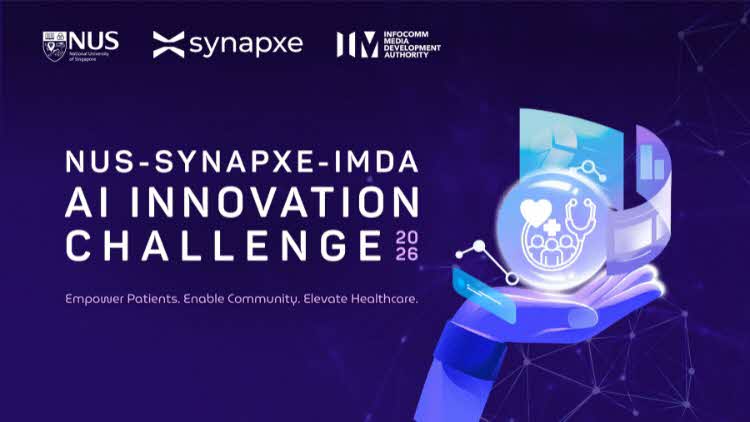
The NUS–SYNAPXE–IMDA AI Innovation Challenge 2026 will be focusing on healthcare to address a pressing national challenge as recent data indicates that diabetes, hypertension, and high lipid levels now affect approximately 1.8 million people, with many unaware of their condition.
Organised by the National University of Singapore (NUS) Business Analytics Centre, national healthtech agency Synapxe, and the Infocomm Media Development Authority (IMDA), the latest edition of the annual competition aims to harness data-driven innovation to prevent complications and reduce avoidable hospitalisations.
Reflecting the theme, “Empower Patients, Enable Community, Elevate Healthcare,” students will be challenged to build AI-powered solutions that:
- Identify at-risk individuals before symptoms appear;
- Support timely screening and diagnosis;
- Enable continuous remote monitoring for chronic conditions, and;
- Empower patients to manage their health effectively from the comfort of their home.
This is the 10th edition of the AI Innovation Challenge since it began in 2016. Initially open to NUS students, the annual Challenge was expanded in 2023 to include polytechnic students and participants from other universities. This year marks another milestone with junior college students coming on board, reflecting their growing engagement with computing, data analytics, and AI through school programmes and extracurricular activities. Their participation encourages early interest in these fields, fosters collaboration and knowledge sharing across institutions, and helps build a sustainable talent pipeline for Singapore’s growing AI ecosystem.
To ensure that their solutions are both practical and relevant, students are encouraged to use the MERaLiON and SEA-LION Large Language Models (LLMs) (see Annex A for details). These two LLMs, developed under the National Multimodal Large Language Model Programme (NMLP) supported by IMDA and the National Research Foundation (NRF), are designed to handle the complex language-switching communication styles and cultural nuances common in local settings. These models reflect Singapore’s and Southeast Asia’s diverse cultures, languages, and values. By understanding local languages and context, they can enable AI‑powered healthcare solutions that are not only linguistically accurate but also empathetic and culturally sensitive. This supports the development of more personalised, inclusive, and accessible healthcare in Singapore.
One student team in the final round of this year’s AI Innovation Challenge that demonstrates the most effective and innovative use of the SEA-LION and MERaLiON models will receive the NMLP Special Award and a cash prize of $5,000.
Professor James Pang, Co-Director of the NUS Business Analytics Centre, said, “The aim for this year's AI Innovation Challenge is to mobilise the next generation of talent to think about critical healthcare challenges and design solutions that harness cutting-edge AI capabilities. Together with Synapxe and IMDA, we want to imbue young innovators with a strong interest in the healthcare sector. Ultimately, we envision solutions that will bring measurable health outcomes and improved quality of life for all Singaporeans.”
Andy Ta, Director of Data aNalytics and AI, and Chief Data Officer at Synapxe says, “As a learning organisation, Synapxe strongly believes in supporting young innovators on their learning journey with the knowledge and skillsets to harness emerging technologies like AI, while incorporating safety, responsibility and trust at every step. By presenting real-world challenges, we aim to spark fresh ideas and help nurture the next generation of healthtech leaders.”
Dr Lawrence Wee, Director for Business & Ecosystems, BizTech Group, IMDA, said, "At IMDA, we are harnessing emerging technologies to benefit Singapore and Singaporeans. Our National Multimodal Large Language Model Programme (NMLP) has produced SEA-LION and MERaLiON – two AI models built with multilingualism and cultural nuance at their core, ready to serve across sectors. In healthcare, for instance, these models can help to bridge the language gap between elderly patients and healthcare professionals, enabling more empathetic, inclusive, and tech-enabled care. Through the NMLP Special Award, we hope to catalyse the use of MERaLiON and SEA-LION by having students use these models to develop practical solutions for our community.”
Registration for the challenge closes on 15 February 2026 at 12 noon. Interested students can visit https://www.sg-innovationchallenge.org/ for details.
